Citizens of Rock n’ Roll,
My YouTube Shorts generated 359,826 views over a year and an estimated $76.64 in Shorts revenue. For a guy with no multi-million-dollar marketing machine behind him, that doesn’t seem like bad organic numbers! But in the end, all the sweat equity works out to about $6.39 a month. I have a Ph.D. in marketing. I can confirm that $6.39 is, technically, money, even if it sucks for the time and financial investment.
This was never going to finance an album, let alone a single. For an independent artist, it was still something. Now YouTube has announced a payment threshold that could turn that small contribution into no contribution from the usual Shorts revenue share. Spotify already has a recording royalty floor that excludes songs below a minimum annual stream count.
Apparently, building an audience and qualifying to be paid for it require separate business plans. That is worth examining. So is my response. I can object to the rules while still asking whether spending more time, and money, chasing the next threshold is a sensible use of an independent musician’s week.
My recommendation is to use these platforms where they help people discover the music, then give those people a reason to stay connected through a website, email list, recurring show or livestream, or direct purchase. Before we add another upload, we need to know what our work is supposed to accomplish. And it’s probably not going to be what you traditionally think it should be.
You can remain a partner while losing the payment
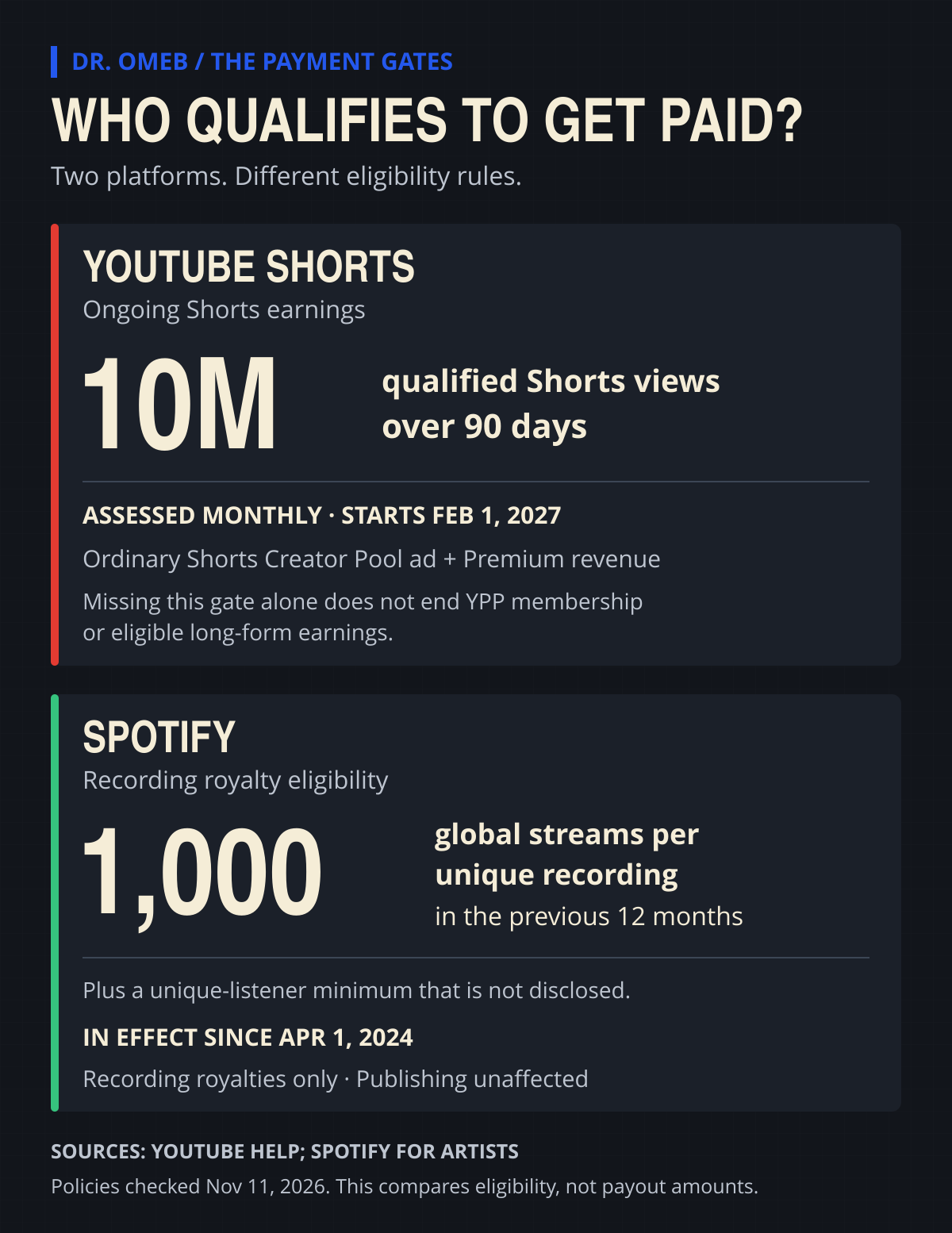
Beginning February 1, 2027, YouTube’s Shorts monetization policy requires 10 million qualified Shorts views over 90 days to qualify each month for ordinary Shorts Creator Pool ad revenue and YouTube Premium revenue. For each earnings month, the assessment uses the 90 days ending on the 15th of the previous month. This is an ongoing earnings requirement, separate from joining the YouTube Partner Program.
YouTube’s explanation of the changes says existing partners do not lose their Partner Program membership merely for missing the Shorts threshold. Eligible long-form earnings can continue. Creators also need to accept the updated monetization terms by January 31, 2027, to continue using the associated earning features.
You can remain a YouTube Partner. Your Shorts just stop qualifying for the usual revenue share. The distinction matters. Being admitted to the program and being eligible for a particular payment are questions an existing creator has to keep asking separately.
Here is what small looks like on my channel
On November 11, 2026, my channel had 34,900 subscribers. Small, certainly. Also an established audience that I’ve spent decades grinding out rather than an account I opened yesterday afternoon.
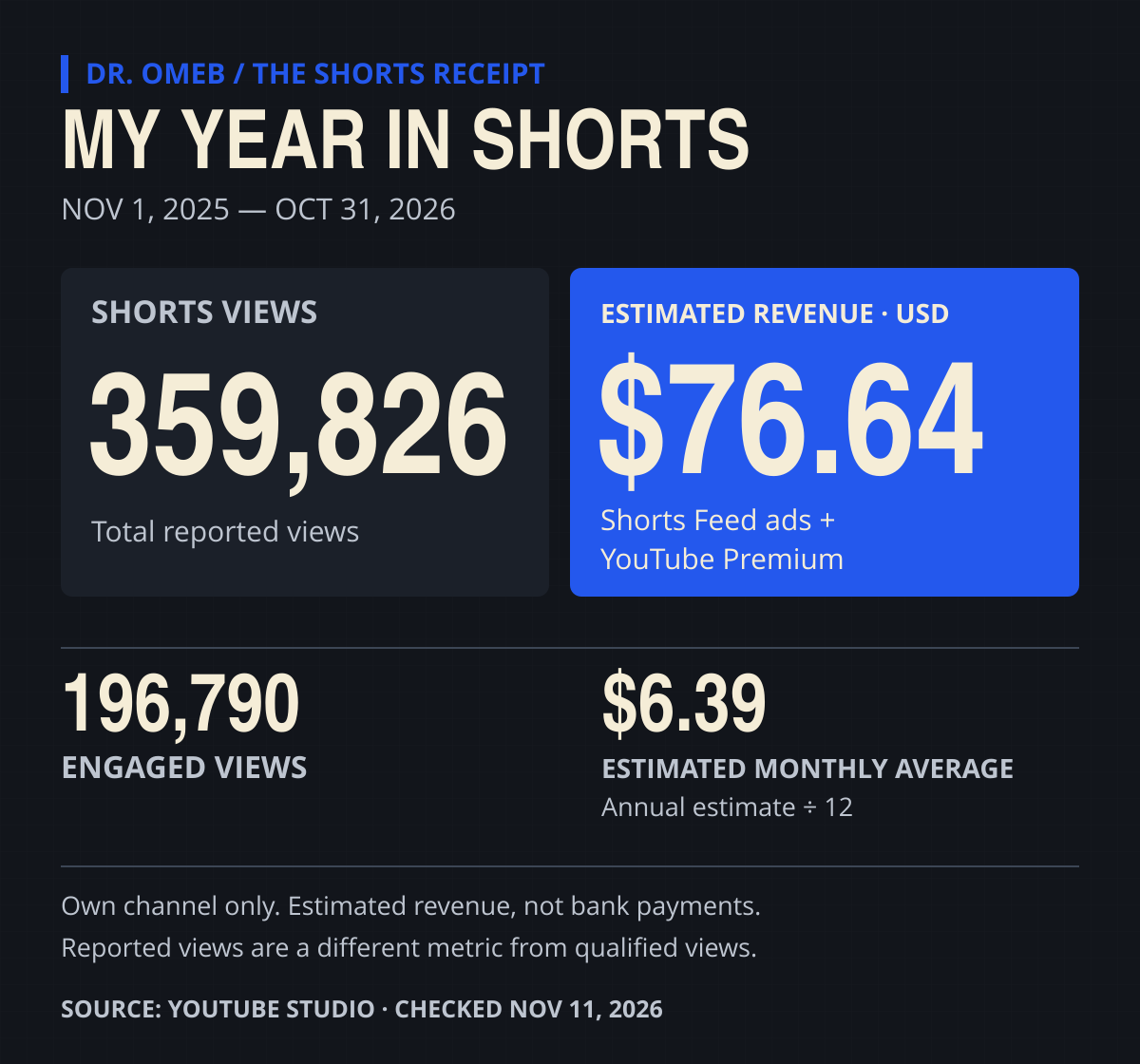
Here is what YouTube Studio reported for my channel’s Shorts across November 1, 2025–October 31, 2026:
View the figures as a table
| Measure | Result |
|---|---|
| Shorts views | 359,826 |
| Engaged views | 196,790 |
| Estimated Shorts Feed ad and YouTube Premium revenue combined | US$76.64 |
| Average per month | US$6.39 |
My latest 90-day report, August 13–November 10, 2026, showed 90,297 total Shorts views and 50,052 engaged views. At that audience level, I would not meet a requirement for 10 million qualified views.
If my Shorts viewership remains at this level, I would lose ordinary Shorts Creator Pool ad and Premium revenue beginning February 1, 2027.
Data note: These are my channel’s YouTube Studio reports, checked November 11, 2026, with other channels excluded. Revenue is estimated in U.S. dollars, not finalized bank payments; US$6.39 is the annual estimate divided by 12. Total views and engaged views are not exact qualified-view counts, and Studio did not expose that eligibility counter in the reports reviewed. This is one channel’s case study, not a typical creator pay rate or an exact forecast of future losses.
$6.39 a month was already a small contribution. The concern is that the same work can continue attracting viewers while that contribution falls to zero if I remain below the threshold. “It wasn’t much anyway” is an odd defense of replacing a small payment with none. Thanks YouTube!
Say I pull a Sabbath riff out of Sunday’s Rock n’ Roll Church and somebody finds the Short on Tuesday. Maybe they show up next Sunday and send a gift while I’m playing. Most gifts are small. Add them up, though, and I earn more in a month from my livestreams than I do from people streaming my recorded music. You’d never know that from looking at what YouTube paid me for the riff.
One Sunday show gives me hours of material to cut into Shorts. And when you see my fingers bend a string, you’re hearing the bend I played in front of everybody that morning. If I come up a little flat, congratulations, you heard that too. We’ve all seen guitar videos where the guy, or girl, is pantomiming along to a perfect studio take. I'd rather give you the clip, warts and all.
Spending Thursday afternoon shooting a whole new video just to feed the Shorts schedule is a different decision, and maybe a waste of time. I could spend those same hours finishing a song. What am I getting for Thursday? I think that’s a fair question to ask of my $6.39-a-month empire, oops I mean $0-a-month empire.
Spotify already draws a line around the recording
Spotify’s policy took effect on April 1, 2024, as its original announcement confirms. It is older than YouTube’s announced change, but relevant to the same question about who qualifies for payment.
Spotify’s current rules require each unique recording to reach at least 1,000 global streams in the previous 12 months, plus a minimum number of unique listeners that Spotify does not disclose. The cutoff affects recording royalties; it does not change publishing royalty calculations.
Consider a hypothetical artist with ten distinct recordings at 900 global streams each over the previous 12 months. That is 9,000 streams across the catalog. None of those recordings meets the numerical threshold. The artist has attracted listening. The recordings still do not qualify.
Let’s say those ten recordings are the ten songs on my album. I’d be pretty pleased to find out people were digging through the whole thing. Then I look at the royalty rules, and suddenly I have a business reason to ask everybody to play the single again. As a musician, I’d love for you to hear track eight. I put it there for a reason.
Here is where the two policies differ:
View policy comparison as a table
| Platform | Relevant threshold | Revenue affected | Timing |
|---|---|---|---|
| YouTube Shorts | 10 million qualified Shorts views over 90 days, assessed monthly | Ordinary Shorts Creator Pool ad and Premium revenue | Starts February 1, 2027 |
| Spotify | At least 1,000 streams per unique recording over the previous 12 months, plus a listener requirement | Recording royalties | In effect since April 1, 2024 |
A bigger payout total does not answer who gets paid
Spotify says tiny payments often fail to reach artists because of distributor withdrawal fees and minimums. It says excluded money is redistributed to eligible recordings without increasing Spotify’s own share. Its October 2026 update also presents the existing floor as a defense against mass-produced AI content.
YouTube’s announcement describes new earning opportunities and says it expects overall creator payouts to grow. Targeted Shorts advertising and bonus programs have separate eligibility conditions. They are not assured replacements for an individual channel’s usual revenue share. Those are explanations to evaluate. They are not evidence that every affected artist comes out ahead.
If a company increases its total payroll while cutting your pay, the larger payroll figure is unlikely to improve your afternoon. You still need to see what happened to your paycheck.
Total payouts and the distribution of those payouts are different questions. A total can grow while some participants lose eligibility altogether. Neither a growing total nor a sensible anti-fraud objective settles what the policy does to a small artist doing legitimate work.
My earlier analysis of streaming royalties reached a related business problem: comparing platforms is useful, but building the entire business around their payment systems leaves the artist dependent on decisions made elsewhere.
The audience does not owe us attention
I have been fairly blunt about this before: nobody owes you attention. Spending months on a song does not obligate somebody to listen. Credentials do not obligate anybody to care. The audience gets a choice.
I stand by that.
But earning attention and qualifying for a platform payment are different matters. Once people do watch or listen, it is reasonable to examine how the business distributes its money and whether participating still makes sense for us.
My irritation with a threshold will not pay for anything. A more useful response is to decide what I want the attention to accomplish before volunteering another week of production.
Give the next hour a better job
Independent artists already write, rehearse, record, perform, edit, promote, and handle the business. We do not need an additional occupation called feeding the upload schedule.
Here is where I would put the effort:
Give interested listeners a way back. Offer a clear reason to join an email list and visit the website. Email still uses service providers, but it gives us a direct contact channel beyond the next recommendation in a feed. We as independent artists gave up control of our communities when we gave up our website for social media. It’s time to take that control back.
Sell a few things worth buying. A recording, ticket, or shirt should offer something the audience actually wants. Calculate the margin after production, fees, shipping, and time. Revenue is the impressive-looking number before the expenses arrive. Remarkably, I’ve been selling a decent amount of T-shirts over the last year! If you know a local printer, ask what they’d charge to print and ship on demand so you don't have to carry stock.
Build a recurring experience. For me, Rock n’ Roll Church gives people a regular place to gather around the music. I’ve spent the last year building a livestreaming community on TikTok that’s grown to 22.2K followers. What gets my attention on Sunday is when the regulars start talking to each other. Now they’ve got another reason to come back, even if they’ve already heard me play the song.
Give each clip a purpose. If the riff is what brought somebody in, make it easy for them to find the full performance or tell them when they can hear the next one live.
Check what the hours produce. Measure revenue, repeat attendance, email signups, and the value of the work itself. Reduce formats that consume the week without contributing to the music or the business.
This does not require turning every song into an advertisement for a shirt. Some music matters because of what it expresses or the connection it creates. I know a Sabbath riff has a better chance of getting somebody in the door. I’d still like them to hear one of mine once they’re here.
I still want people to discover me on YouTube and Spotify. I would also like to be paid for the work. Until those interests line up more reliably, I intend to give the audience somewhere to go beyond another eligibility calculation.
Rock n’ Roll Church streams Sundays at 9:00 a.m. Eastern. Visit onemanelectricalband.com to explore the music and join the congregation.
Join the Congregation
Rock n' Roll Church streams live every Sunday at 9:00 AM Eastern. Come for the music. Stay for the people who still believe rock deserves a room.