
Citizens of Rock n' Roll,
In 2019, I successfully defended a Ph.D. dissertation built on roughly 1.2 million line-item streaming transactions from eight independent musicians. The study examined royalty reporting from ten services between 2014 and 2018 and asked a basic question: did the platforms pay independent artists in comparable ways for the same basic product?
The answer was no. Not remotely.
The research never became the journal article I intended. Life got busy, the dissertation sat in a drawer, and the streaming business kept moving. In 2026, I pulled the work back out and compared it with my own lifetime distributor report: 40,314 transactions going back to 2007.
The old analysis still had something to say. But the most important lesson was no longer which platform paid the highest average. It was how dangerous it is for an artist to build a business entirely inside a room controlled by someone else.
What the dissertation actually measured
The original dataset covered Amazon, Apple, Deezer, Google, iHeartRadio, Pandora, Slacker, Spotify, Tidal, and YouTube. I aggregated the transaction records into 3,054 monthly platform-level observations and used a one-way analysis of variance followed by Tukey pairwise comparisons.
Roughly 86% of the platform-to-platform comparisons were statistically significant. Thirty software outputs displayed the probability value as .000; the correct way to report that is p < .001, not that the probability was literally zero.
That distinction matters. So does another: the data demonstrated large differences between platform averages. It did not, by itself, prove exactly why each difference existed.
Tidal and iHeartRadio appeared near the top of the historical data, while Spotify and Apple appeared lower. My original discussion proposed several possible explanations, including the maturity of each service and the mechanics of pro-rata pools. Those remain hypotheses, not causal findings.
My own royalty history became an out-of-sample check
My CD Baby report was not part of the dissertation. That made it useful as a limited, one-artist comparison with the historical period.
For 2014 through 2018, the rank order in my own data broadly resembled the dissertation sample. Tidal averaged about $0.0116 in my historical comparison, compared with $0.0122 in the dissertation. iHeartRadio was about $0.0142 versus $0.0140. YouTube was about $0.0061 versus $0.0057. Spotify was lower in my data—about $0.0035 versus $0.0042—but remained among the lower-paying services in the comparison.
That is encouraging evidence that the historical pattern was not unique to the original eight artists. It is not a full scientific replication. One additional artist cannot provide that. It is better described as an out-of-sample check that landed surprisingly close.
The reporting changed in 2024
When I extended my personal analysis forward, my distributor statements began showing Spotify recording revenue of $0.00 for quarters in which streams were still being reported. Other services continued producing small payments.
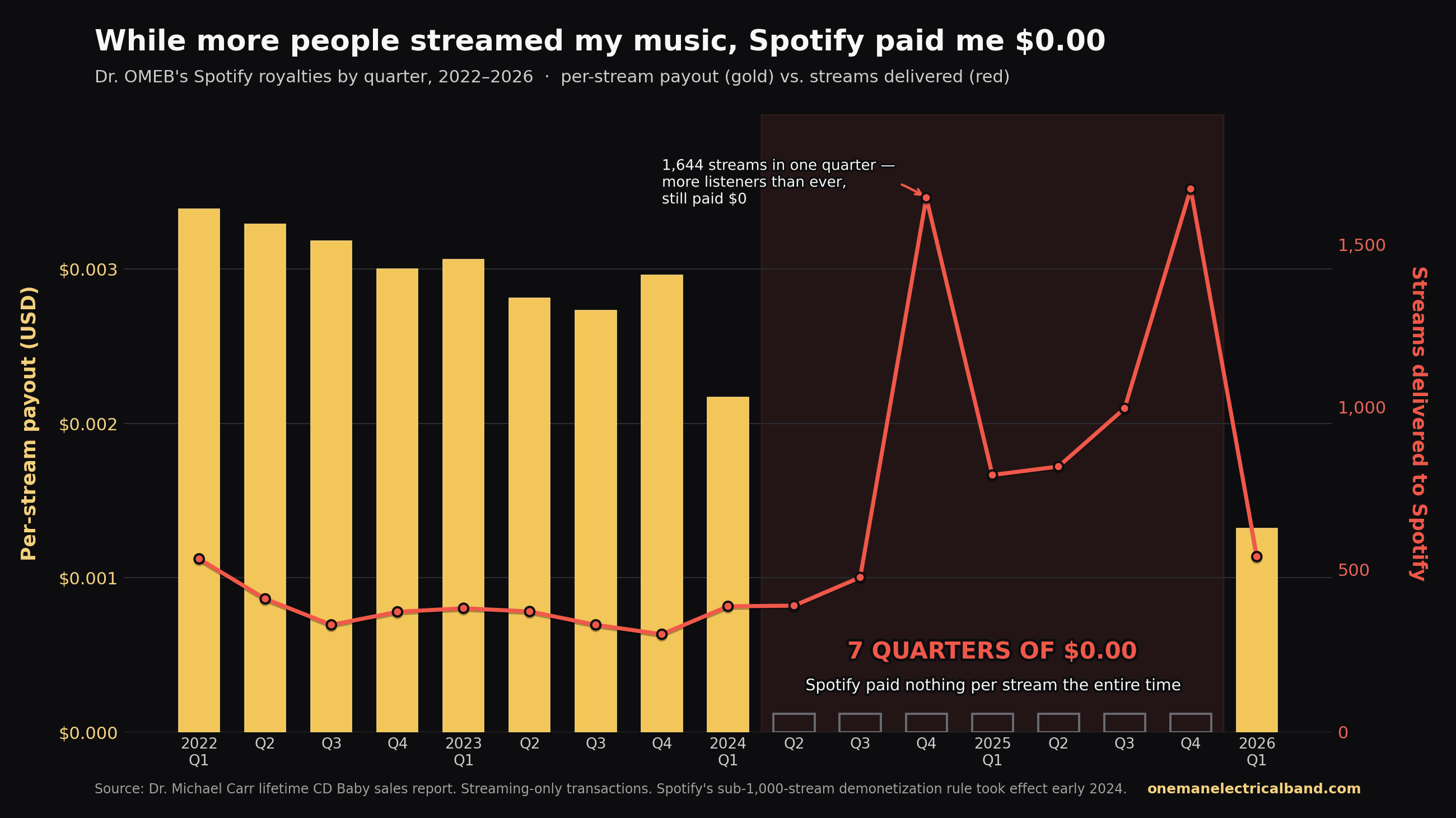
Spotify’s policy, effective in April 2024, requires each unique recording to reach at least 1,000 streams during the previous twelve months and satisfy an undisclosed minimum unique-listener threshold before it enters the recorded-music royalty-pool calculation. The company says the rule applies to recording royalties, not publishing royalties, and that the pool itself is reallocated among eligible tracks.
That makes the pattern in my statements consistent with the eligibility rule. I cannot prove from the distributor export alone that every zero-payment row was caused by it. Rights accounting moves through distributors, territories, reporting delays, and multiple eligibility filters. That is why the revised claim is more precise than the original headline: my statements showed streams while reporting no Spotify recording revenue; Spotify’s current threshold is the leading explanation.
The catalog is becoming unimaginably crowded
The royalty question now sits inside a supply problem that barely existed at this scale when I began the dissertation. Luminate reported 253 million audio ISRCs registered at digital service providers in 2025. In July 2026, Deezer reported that fully AI-generated music had exceeded half of new deliveries on peak days in June, averaging approximately 90,000 AI-generated tracks per day that month.
Those figures do not prove that AI caused Spotify’s policy. Spotify describes the threshold partly as a way to discourage high-volume artificial-streaming schemes and to redirect very small recording payments toward eligible tracks. The broader point is that the catalog is expanding far faster than human attention.
More supply does not automatically create more demand. It creates more competition for search results, playlists, recommendations, and the listener’s fixed number of hours.
Streaming is distribution, not the whole business
Streaming still matters. It is how people expect to hear music. It provides discovery, convenience, social proof, and a permanent shelf for the catalog. Removing music from the major services would make the artist harder to find without repairing the underlying economics.
The mistake is expecting the shelf to become the entire store.
Spotify also explains that it does not pay a fixed per-stream rate. Payments depend on streamshare, markets, rightsholder agreements, and the path from platform to label or distributor. That makes simple “one million streams equals X dollars” claims attractive—and usually incomplete.
An independent artist needs a portfolio of rooms:
- Streaming services for access and discovery.
- Video and social platforms for reach.
- Live performance for connection.
- Email and the artist’s own website for an owned relationship.
- Merchandise, direct music sales, memberships, and experiences for revenue the artist can influence more directly.
Change the room
The most important update to my dissertation is not another platform ranking. It is the realization that optimizing harder inside a weak room does not necessarily fix the room.
Rock n' Roll Church has generated a more direct relationship with listeners than my streaming dashboards ever did. I can see people return. I can hear what they request. I can turn a performance into community, clips, email growth, music discovery, and merchandise interest. Not every one of those benefits pays immediately, but together they create an asset that is larger than a royalty line.
That does not make streaming useless. It puts streaming in its proper place.
Do not abandon the platforms. Stop asking the platforms to be your entire career.
The data from 2019 warned that royalty outcomes varied wildly between rooms. The lesson in 2026 is that artists need to build at least one room of their own.
Sources and limits
- Spotify for Artists: Track monetization eligibility
- Spotify for Artists: Understanding Spotify royalties
- Luminate: 253 million audio ISRCs registered at DSPs in 2025
- Deezer: AI-generated music exceeded 50% of new uploads at peak in June 2026
The transaction counts, platform comparisons, and distributor observations are based on my dissertation dataset and personal royalty statements. They should not be read as a universal estimate of what every artist earns.
Join the Congregation
Rock n' Roll Church streams live every Sunday at 9:00 AM Eastern. Come for the music. Stay for the people who still believe rock deserves a room.