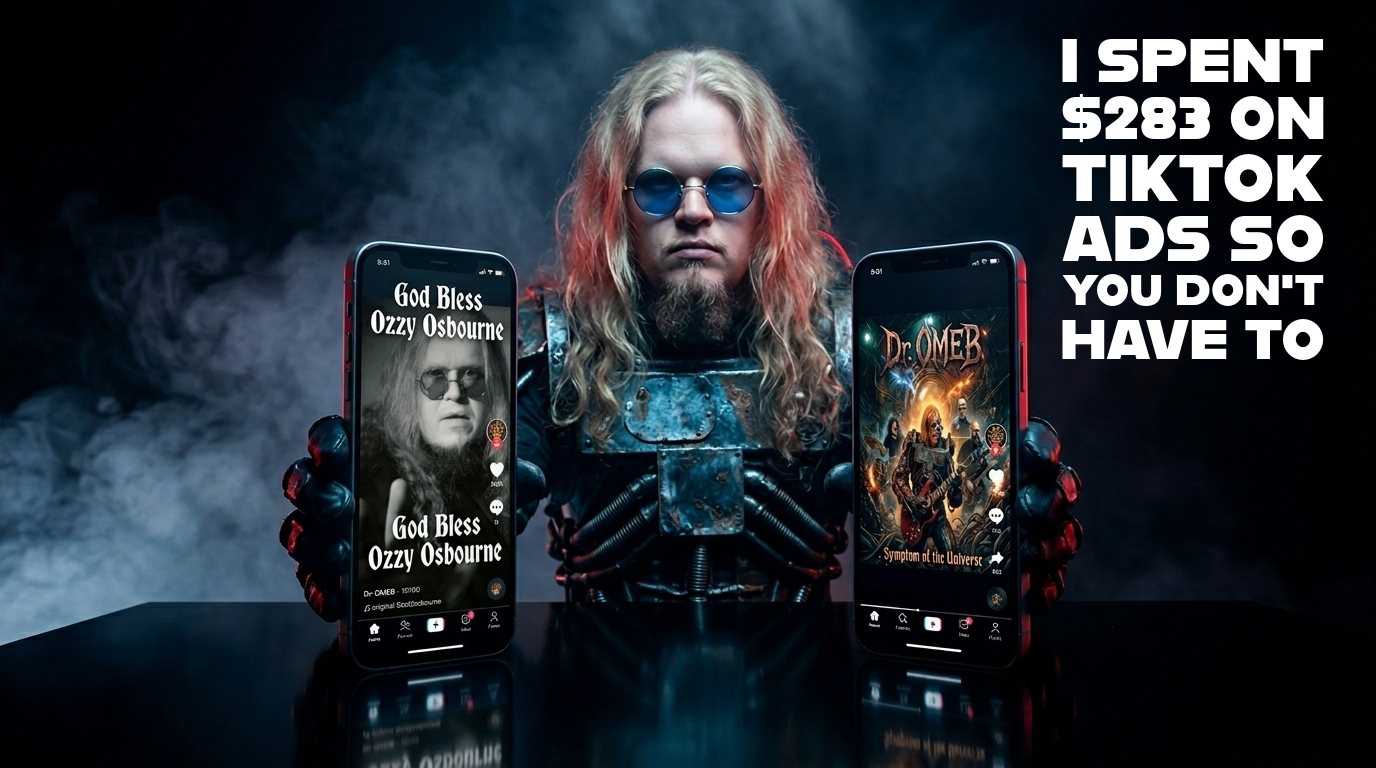
Citizens of Rock n' Roll,
I spent $283.08 promoting two of my music videos through TikTok Spark Ads. One campaign amplified an Ozzy Osbourne tribute that had already found an audience. The other tried to rescue a carefully produced Black Sabbath collaboration that the platform had largely ignored.
The result was useful—but not for the reason I originally wrote.
This was a practical field comparison, not a randomized controlled experiment. The campaign settings were similar, but the videos were not equivalent. They entered paid distribution with different organic histories, different cultural context, and different emotional framing. That means the numbers can reveal patterns and guide a next test. They cannot prove that one creative variable caused every difference.
The two campaigns
Both campaigns used the community-interaction objective with follower growth as the practical goal. Both targeted adults thirty-five and older in the United States, Brazil, and Mexico. Both used Spark Ads, which promote an existing TikTok post rather than an entirely separate advertisement.
That is where the similarity ends.
Campaign A: The Ozzy tribute
The first post was my cover of “Close My Eyes Forever,” reposted as a tribute after Ozzy Osbourne’s death. Before the campaign began, the post had already reached 45,334 organic views and gained 268 followers. Search demand and public emotion were already present.
Campaign B: “Symptom of the Universe”
The second post promoted my Black Sabbath cover featuring Vinny Appice. It represented more than sixty hours of production work, a bucket-list collaboration, and an ambitious AI-assisted video. After thirty-five days, the TikTok post had reached only 415 views.
One post had momentum. The other had craftsmanship without momentum. That difference matters before a dollar enters the system.
The results
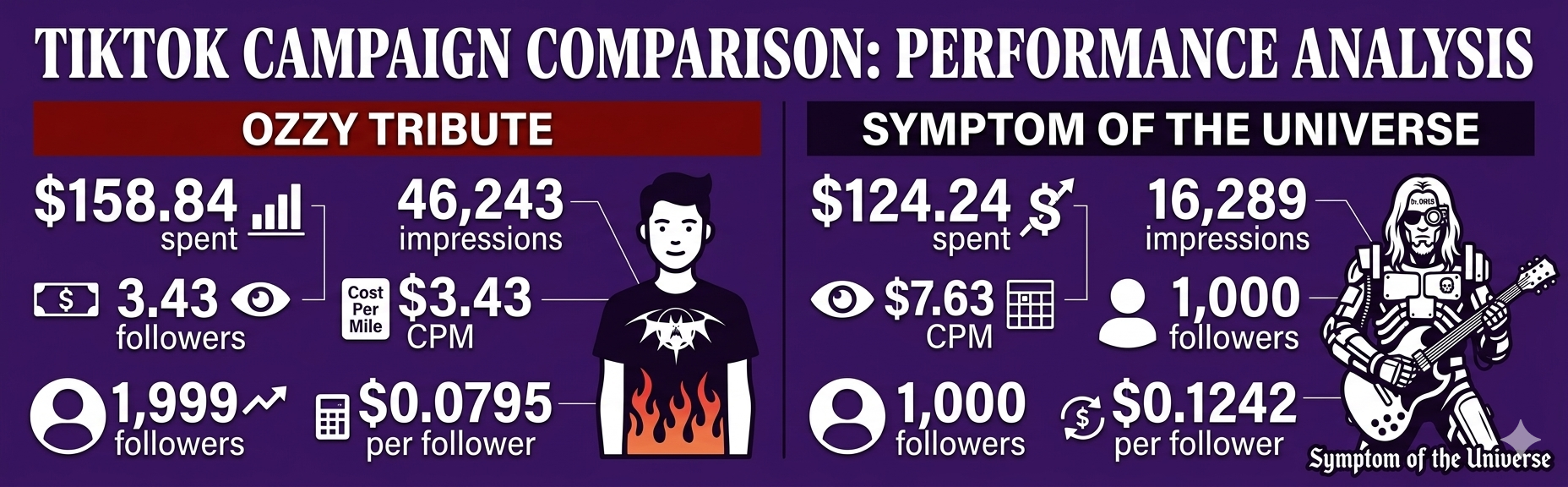
| Metric | Ozzy tribute | Symptom campaign |
|---|---|---|
| Spend | $158.84 | $124.24 |
| Impressions | 46,243 | 16,289 |
| CPM | $3.43 | $7.63 |
| Followers attributed | 1,999 | 1,000 |
| Cost per follower | $0.0795 | $0.1242 |
| Pre-campaign organic views | 45,334 | 415 |
| Major traffic signal | 25.5% search | 97.5% For You feed |
The Ozzy tribute produced impressions at less than half the CPM and added followers at a lower cost. The campaign also spent faster against the post with stronger existing audience signals.
The “Symptom” campaign still generated followers. It was not a total failure. The higher cost was consistent with its weaker starting signals, but this comparison cannot isolate the cause.
What the test supports
The evidence supports three practical observations.
1. Paid distribution worked more efficiently when organic signal already existed
The Ozzy post had accumulated views, follower conversion, and search activity before promotion. The platform already had information about likely viewers. The ad did not create that fit; it expanded it.
2. The emotional premise was immediately legible
A tribute communicates grief, respect, and shared memory in a few seconds. The “Symptom” post led with production value and credentials. Those are meaningful after someone understands the story, but they require more context.
3. Expensive work is not automatically clear work
I was proudest of the Vinny Appice collaboration, so I assumed the audience would recognize its importance immediately. That was an artist’s assumption, not an audience insight. The most valuable part of the project was human: recording a legendary Sabbath song with one of my childhood heroes. I buried that story under the production.
What the test does not prove
It does not prove that emotional content always beats production value. It does not establish a universal CPM cutoff. It does not prove that TikTok permanently rejected the second video. It does not isolate Ozzy-related search interest from the creative itself.
A different edit of “Symptom,” led by the human collaboration instead of the visual spectacle, might have performed very differently. That is the next useful test.
The original version of this article turned two campaigns into a rule. The revised version treats them as evidence—strong enough to change my behavior, not strong enough to become a law of marketing.
The part an independent creator can use
Before paying to amplify a post, ask:
- Is there organic evidence of fit? Look at retention, shares, comments, search traffic, and follower conversion—not only raw views.
- Is the human reason to care visible immediately? Do not make the viewer decode the credits before understanding the stakes.
- Am I amplifying a winner or trying to purchase a second opinion? Paid media can test new distribution, but it cannot make a confusing premise clear.
- What would I change if the campaign costs more? Decide in advance whether the response is to stop, revise, retarget, or accept the higher acquisition cost.
Watch the early metrics, but do not worship a benchmark stripped of context. Cost varies by market, objective, audience, creative, season, and platform conditions. Your own comparable campaigns are often the best benchmark you have.
Advertising is an amplifier
An amplifier does not repair the signal. It makes the signal louder.
The best use of paid media in this test was not forcing the platform to love the post I loved. It was extending content that had already demonstrated a clear audience response.
My next version of the “Symptom” story should not begin with how many hours the video required. It should begin with what it felt like to record Black Sabbath with Vinny Appice. The facts are still there. The audience simply needs the reason to care first.
That is the lesson $283 bought me.
Join the Congregation
Rock n' Roll Church streams live every Sunday at 9:00 AM Eastern. Come for the music. Stay for the people who still believe rock deserves a room.