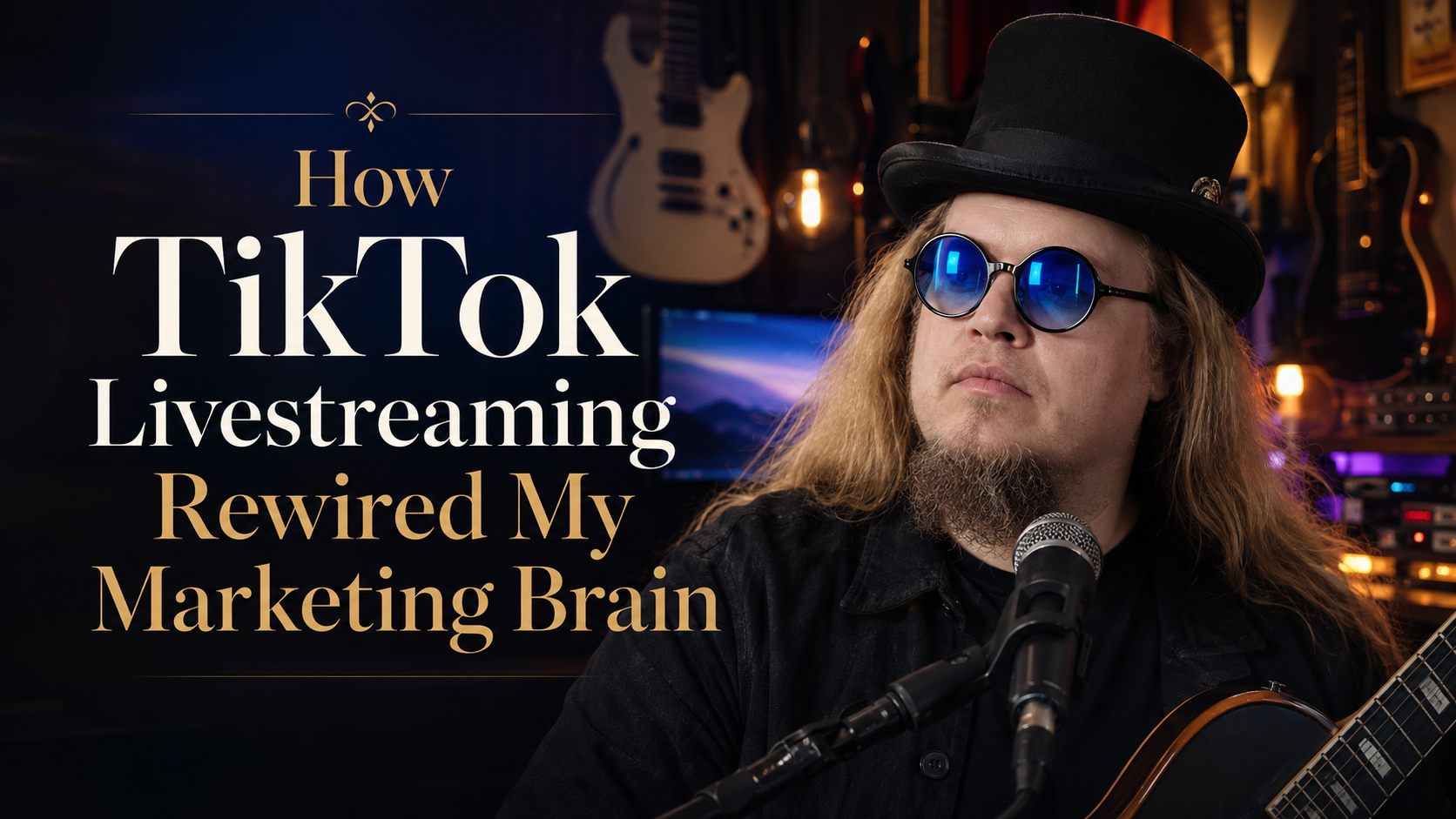
Citizens of Rock n' Roll,
A little over a year ago, I was ready to quit playing music. I had canceled my gigs and more or less decided that the part of my life built around loading equipment into bars, playing for a few hours, tearing it all down, and doing it again the next weekend had reached its natural end.
That does not mean I was ungrateful for the people who came to see me. I was. But after more than twenty years, live music had become a job with a very narrow definition of success: play the gig, collect the check, and put the next date on the calendar. I was no longer building an audience. I was servicing a schedule.
Then my friend Alexa told me I needed to livestream on TikTok.
“Nobody is going to watch my old fat ass play classic rock on TikTok.”
That was my professional assessment. I have a Ph.D. in marketing, which apparently does not prevent a person from being spectacularly wrong in public.
The room was never the building
For most of my career, “live music” meant a physical venue. A musician booked a show, promoted it, performed it, and hoped enough people came through the door. That was the model I understood because it was the model I had lived.
Livestreaming initially felt like something adjacent to a concert rather than a legitimate version of one. That assumption did not survive very long once I actually started doing it.
In a bar, many people are there to drink, talk, watch a game, or spend an evening with friends. The musician may be important, but the musician may also be part of the wallpaper. Online, the exit is a single swipe. Staying is a decision. Commenting is a decision. Sharing the stream is a decision. Returning the following Sunday is another decision.
That changes what attention means. It also changes what the performance means.
The audience moved onto the stage
During a livestream, I can see comments while I am playing. I can recognize someone entering the room, react to a joke, answer a question between songs, acknowledge a request, or point out something one of the moderators has said. The regular viewers begin to recognize one another. Conversations continue from week to week. Relationships form that do not depend entirely on me.
The audience is no longer simply standing in front of the stage. In many ways, the audience is on the stage with me.
That is the foundation of Rock n' Roll Church. The name did not create the community. The community made the name obvious. What began as me playing songs into a phone became a recurring gathering with its own regulars, language, requests, jokes, rituals, and sense of belonging.
It rewired what I measure
For years, the main metric attached to a live performance was financial: Did the gig pay enough to justify the work? Revenue still matters. Pretending otherwise is how musicians stay exhausted and broke. But it is no longer the only thing I measure.
Now I watch how many people enter, how long they stay, how many participate, how many share the stream, how many follow, and—most important—how many familiar names return. Those signals tell me whether people are choosing to become part of something.
A follower count can grow while the room gets colder. A community can be relatively small while becoming more valuable every week. Repeat attendance is the difference. The goal is not merely to make a person notice Dr. OMEB once. The goal is to give that person a reason to come back.
The performance became the content engine
Traditional gigs were terrible content factories. Dark rooms, poor camera angles, inconsistent phone audio, and hours of footage that still needed to be hunted manually for one useful moment.
A livestream creates a different cycle:
- The live performance builds community.
- The community creates interaction and memorable moments.
- Those moments become short-form clips.
- The clips introduce new people to the next live performance.
The stream is no longer a single event that disappears when the final chord rings out. It becomes the source material for the rest of the content system. One performance can create community, audience growth, music discovery, and weeks of usable video.
That is the kind of leverage a one-person operation needs. I am the musician and a major part of the production, marketing, editing, and business. Anything that produces only one benefit is expensive. Livestreaming produces several.
Experience can become a blindfold
I should have recognized all of this sooner. My entire career has involved challenging conventional assumptions. When I built the One Man Electrical Band, plenty of people doubted that one musician could convincingly perform the kind of hard rock I wanted to play. I experimented anyway.
Yet after two decades of performing, I had developed my own rigid idea of what a “real” live show was. Experience taught me a great deal, but it also made one format feel inevitable.
One of my moderators, DJ Helly, eventually described the stream in a way that corrected my thinking: this is not merely a livestream; it is a virtual concert.
The venue changed. The purpose did not. I am still playing music for people who want to hear it. The difference is that the room can extend around the world, the audience can participate in real time, and the relationship does not end when the set does.
The real marketing lesson
There is no magic formula hiding in this story. Some streams perform better than others. Some ideas connect immediately; some fall flat. Anyone selling certainty about an audience platform is probably selling something other than certainty.
The useful lesson is simpler: do not confuse the system you know with the need it serves.
I thought the room was the bar, the club, or whatever physical venue had hired me that night. The room was never the building. The room is wherever the people who care about what you create are willing to gather.
Sometimes the most valuable thing a marketer can discover is not a new tactic. Sometimes it is realizing that the room has changed.
Join the Congregation
Rock n' Roll Church streams live every Sunday at 9:00 AM Eastern. Come for the music. Stay for the people who still believe rock deserves a room.